
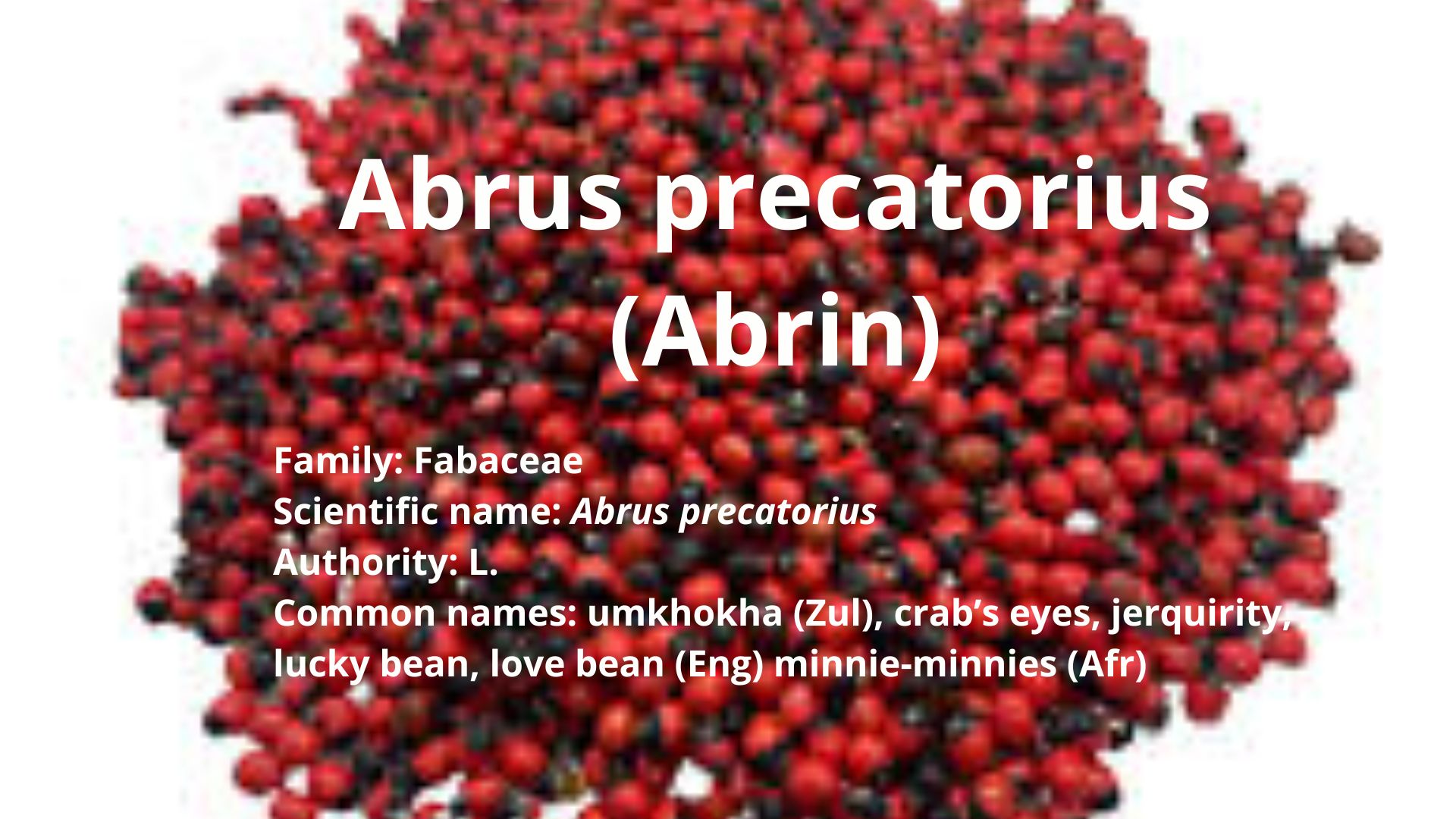
Family: Fabaceae
Scientific name: Abrus precatorius
Authority: L.
Common names: umkhokha (Zulu), crab’s eyes, jerquirity, lucky bean, love bean (English) minnie-minnies (Afrikaans)
Description: A. precatorius is a woody twining shrub that is widely distributed in the eastern and northern parts of South Africa. It has compound leaves with small 10 or more pairs of leaflets, purple inconspicuous flowers borne in dense clusters, and pods containing 3 to 5 bright red seeds with patches of black around the hilum.
Type of toxin: The seeds contain one of the most deadliest toxins, a lectin called abrin. There have been reports of fatal poisoning in domestic animals and humans.
How the toxin works: Abrin works by inhibiting protein synthesis in cells. The toxin has two polypeptide chains that are joined by a disulphide bond. The one peptide bond is able to inactive ribosomes, the other is known to bind the toxin to the cell surface.
The symptoms: The symptoms always appear after a latent period of several hours, and include loss of appetite, inflammation, and haemorrhage.
Uses in traditional medicine:
Deadly plants are a double edge sword meaning they can both take and give life. When used as is, the seeds are poisonous and deadly. But once boiled in water or milk the toxin is neutralized and the seeds may be used for the following:
- The seeds are used as an aphrodisiac
- The seeds are used as an oral contraceptive.
- The seeds are used to make an emetic, purgative, and tonic.
- The seeds are ground to powder and used to treat ophthalmia.
- The seeds are ground to powder and used to treat snake bites.
- The seeds are ground to powder and used to treat ulcers and intestinal worms.
- The seeds are used to make rosary and jewellery.
- The seeds are considered a love charm.
Buy Abrus precatorius (umkhokha) seeds (→) : https://imithiyesintu.co.za/shop/umkhokha-abrus-precatorius-seeds/
Reference and further reading:
- Attal, A.R., Otari, K.V., Shete, R.V., Upasani, C.D. and Nandgude, T.D., 2010. Abrus precatorius Linnaeus: a phytopharmacological review. Journal of Pharmacy Research, 3(11), pp.2585-2587.
- Bhakta, S. and Das, S.K., 2020. The medicinal values of Abrus precatorius: a review study. J Adv Biotechnol Exp Ther, 3(2), pp.84-91.
- Bhatia, M., Siddiqui, N. and Gupta, S., 2013. Abrus precatorius (L.): An evaluation of traditional herb. J Pharm Res, 3, pp.3296-315.
- Chaudhari, K.S., Ramakant, S., Pawar, P.S. and Kashikar, V.A., 2012. Pharmacological activities of Abrus precatorius Linn.-a review. International Journal of Ayurvedic and Herbal Medicine, 2(2), pp.336-348.
- Das, A., Jain, V. and Mishra, A., 2016. A brief review on a traditional herb: Abrus precatorius (L.). Int J Forensic Med Toxicol Sci, 1(1), pp.1-10.
- Garaniya, N. and Bapodra, A., 2014. Ethno botanical and Phytophrmacological potential of Abrus precatorius L.: A review. Asian Pacific journal of tropical biomedicine, 4, pp.S27-S34.
- Karthikeyan, A. and Amalnath, S.D., 2017. Abrus precatorius poisoning: a retrospective study of 112 patients. Indian journal of critical care medicine: peer-reviewed, official publication of Indian Society of Critical Care Medicine, 21(4), p.224.
- Okhale, S.E. and EM, N., 2016. Abrus precatorius Linn (Fabaceae): phytochemistry, ethnomedicinal uses, ethnopharmacology and pharmacological activities. Int J Pharm Sci Res, 1, pp.37-43.
- Qian, H., Wang, L., Li, Y., Wang, B., Li, C., Fang, L. and Tang, L., 2022. The traditional uses, phytochemistry and pharmacology of Abrus precatorius L.: a comprehensive review. Journal of Ethnopharmacology, 296, p.115463.
- Ragasa, C.Y., Lorena, G.S., Mandia, E.H., Raga, D.D. and Shen, C.C., 2013. Chemical constituents of Abrus precatorius. Amer J Essent Oils Nat Prod, 1(2), pp.7-10.
- Solanki, A. and Zaveri, M., 2012. Pharmacognosy, phytochemistry and pharmacology of Abrus precatorius leaf: A review. International journal of pharmaceutical sciences review and research, 13(2), pp.71-76.
- Subrahmanyan, D., Dks, J.M. and Raj, M., 2008. An unusual manifestation of Abrus precatorius poisoning: a report of two cases. Clinical toxicology, 46(2), pp.173-175.