
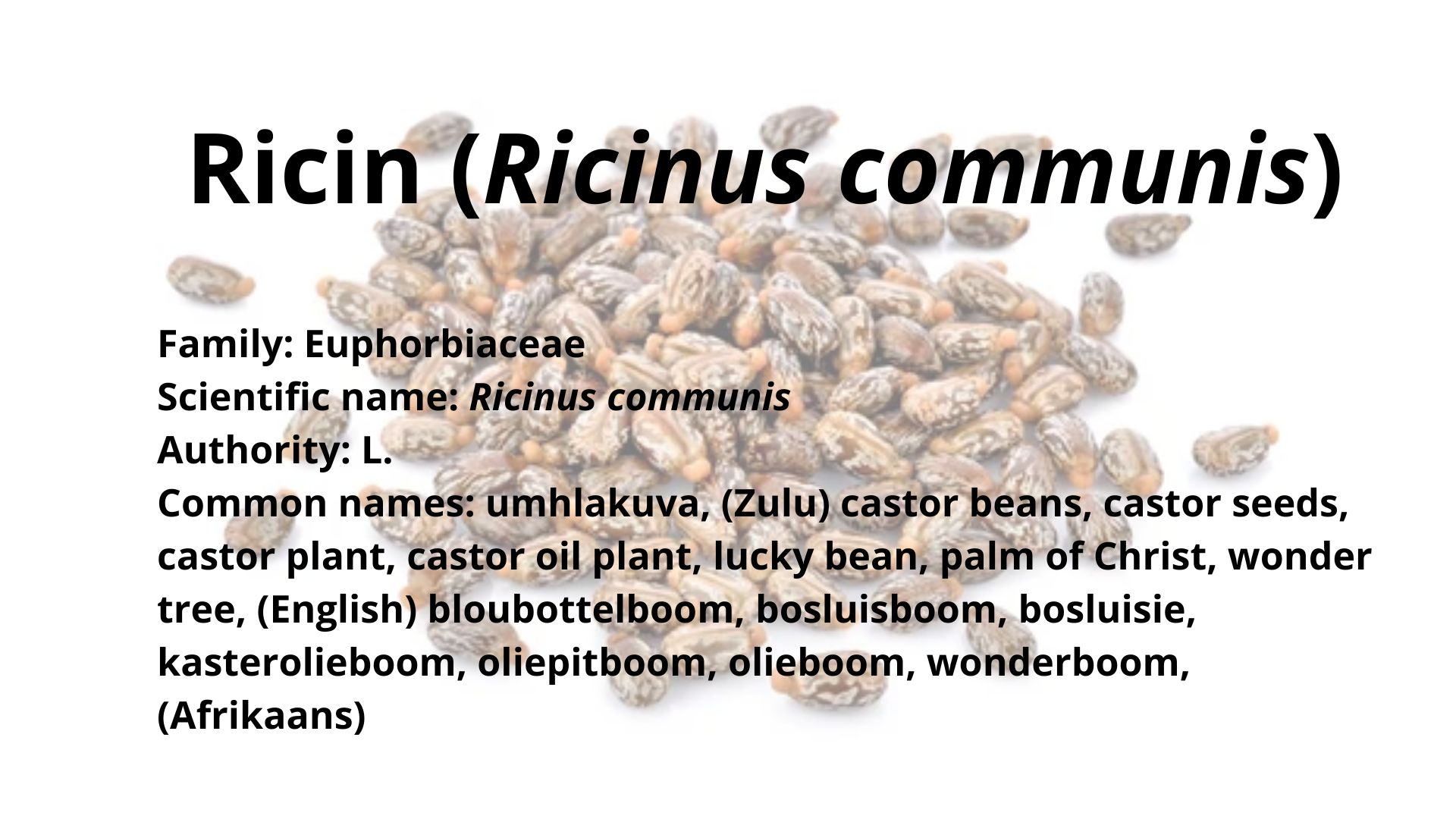
Family: Euphorbiaceae
Scientific name: Ricinus communis
Authority: L.
Common names: umhlakuva, (Zulu) castor beans, castor seeds, castor plant, castor oil plant, lucky bean, palm of Christ, wonder tree, (English) bloubottelboom, bosluisboom, bosluisie, kasterolieboom, oliepitboom, olieboom, wonderboom, (Afrikaans)
Description
Ricinus communis is an evergreen, fast-growing perennial shrub or soft-wooded small tree widely distributed throughout warm temperate and tropical regions. The plant has large, palmate, deeply lobed leaves that are green or reddish in colour. It is monoecious, bearing male and female yellowish flowers on the same plant. The fruit is a three-celled, spiny capsule that turns brown when mature and contains oval, brown-mottled seeds with a warty appendage known as the caruncle.
The plant is cultivated as an ornamental species, for sand-dune stabilisation, and for the production of castor oil from its seeds.
Type of Toxin
The seeds contain ricin, a highly potent and deadly lectin toxin. Historically, ricin has been used to cause fatal poisoning in domestic animals and humans. A well-known case is the assassination of Bulgarian dissident writer Georgi Ivanov Markov, who was fatally poisoned with ricin.
Mechanism of Action
Ricin inhibits protein synthesis within cells. The toxin consists of two protein chains joined by a disulphide bond.
- One chain inactivates ribosomes, halting protein production.
- The other chain binds the toxin to the cell surface and facilitates entry into the cell.
This process prevents elongation factors from functioning, effectively stopping protein synthesis. The resulting cellular stress and inflammatory responses lead to tissue damage, organ failure, and potentially death.
Symptoms of Poisoning
Symptoms depend on the route of exposure and usually appear after a latent period of several hours.
- Inhalation: when ricin is inhaled symptoms may include fever, chest tightness, coughing, difficulty breathing, and pulmonary oedema (fluid accumulation in the lungs).
- Ingestion: when ricin is ingested symptoms may include vomiting, diarrhoea, loss of appetite, inflammation, and haemorrhage.
- Injection: when ricin is injected symptoms may include rapid organ failure and severe systemic effects.
Uses in Traditional and Industrial Applications
Although highly toxic, Ricinus communis is considered a “double-edged sword” due to its medicinal and industrial value when properly processed and used
Raw castor seeds are extremely poisonous; however, boiling / cooking in water or milk neutralises the toxin, allowing the following use.
Castor Oil Uses
Castor oil extracted from the seeds is used:
- As a purgative and laxative
- As a lubricant, fuel, hydraulic fluid, and brake fluid
- In cosmetics and soaps
- In printer’s ink, varnishes, and paints
- In plastics, fibres, textile dyes, and leather finishes
- In embalming fluids
- In adhesives and waxes
- In fungicide production
After oil extraction, the remaining seed cake is cooked to destroy toxins and used as fertiliser and, in some cases, incorporated into animal feed.
Use the link to purchase castor seeds: https://imithiyesintu.co.za/shop/castor-bean-seeds-25/
Reference and further reading:
- Audi, J., Belson, M., Patel, M., Schier, J. and Osterloh, J., 2005. Ricin poisoning: a comprehensive review. Jama, 294(18), pp.2342-2351.
- Bradberry, S.M., Dickers, K.J., Rice, P., Griffiths, G.D. and Vale, J.A., 2003. Ricin poisoning. Toxicological reviews, 22(1), pp.65-70.
- Jena, J. and Gupta, A.K., 2012. Ricinus communis Linn: a phytopharmacological review. International Journal of Pharmacy and Pharmaceutical Sciences, 4(4), pp.25-29.
- Olsnes, S. and Kozlov, J.V., 2001. Ricin. Toxicon, 39(11), pp.1723-1728.
- Rana, M., Dhamija, H., Prashar, B. and Sharma, S., 2012. Ricinus communis L.—a review. Int J PharmTech Res, 4(4), pp.1706-1711.
- Worbs, S., Köhler, K., Pauly, D., Avondet, M.A., Schaer, M., Dorner, M.B. and Dorner, B.G., 2011. Ricinus communis intoxications in human and veterinary medicine—a summary of real cases. Toxins, 3(10), pp.1332-1372.